Please wait...

Emergency Medicine

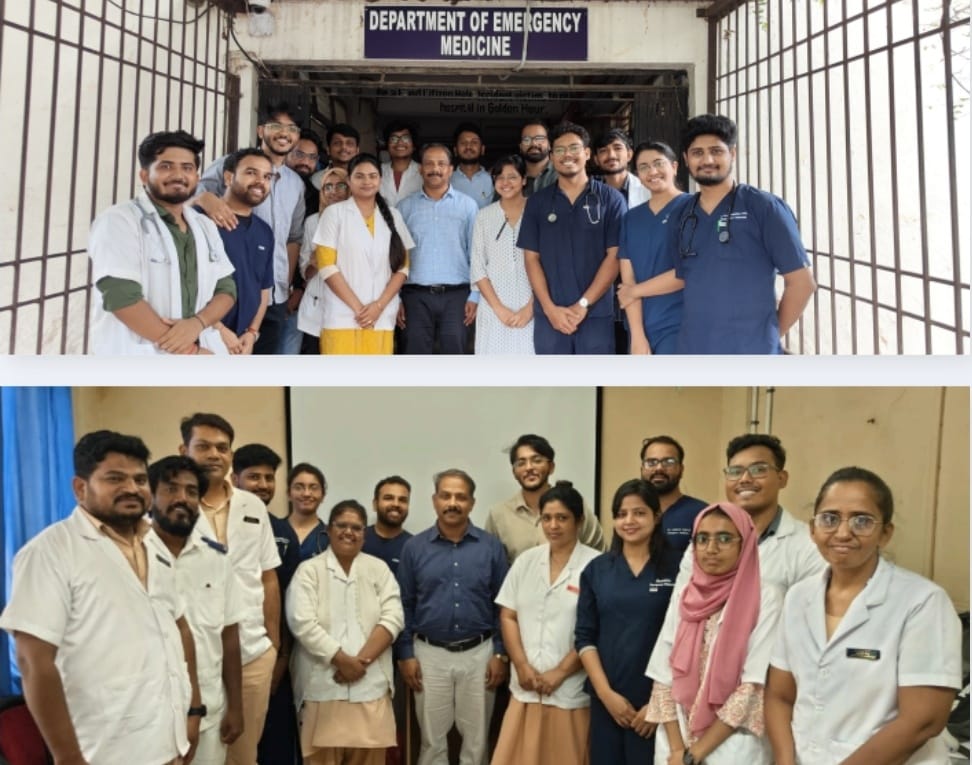
Department of Emergency Medicine

History
The Department of Emergency Medicine at Government Medical College and Hospital, Miraj, was established in 2017 as the first-ever Department of Emergency Medicine in Maharashtra, pioneering specialized acute care services and training in the state.  
In 2020, the department further strengthened its academic contributions by launching post-graduate (PG) courses in Emergency Medicine, enhancing its role in producing skilled emergency care professionals.  


Current Status and Growth:  
- Leadership: The department is headed by one Professor and Head of Department (HOD), who oversees its clinical, academic, and research activities.  
- Academic Output: The department admits two PG students annually. As of now, two batches of post-graduate trainees have successfully completed their training and graduated, contributing to the workforce in emergency medicine across India.
- Legacy: Retaining its status as Maharashtra’s first dedicated Emergency Medicine department, it continues to serve as a model for emergency care education, research, and practice in the region.
This trajectory from its foundational years as a trailblazer to becoming a hub for postgraduate education reflects the institution’s commitment to excellence in emergency medical training and patient care.
Department Attractions
The Department of Emergency Medicine at GMCH Miraj offers several key features that make it a center of excellence in acute care training and service:
•    State-of-the-Art Emergency Setup: Fully equipped emergency department with modern resuscitation bays, trauma care units, and advanced monitoring systems.
•    Multidisciplinary Approach: Collaborative patient management with departments like Internal Medicine, Surgery, Orthopedics, Anaesthesia, and Neurosurgery for comprehensive emergency care.
•    24/7 Emergency Services: Round-the-clock availability of emergency physicians, ensuring rapid and effective treatment for critically ill patients.
•    Simulation-Based Training: Hands-on experience with high-fidelity mannequins and simulation models to enhance practical skills in emergency procedures.
•    Research and Innovation: Active participation in clinical research, national conferences, and workshops, fostering innovation in emergency medicine.
•    Advanced Life Support Training: Regular certification courses in BLS (Basic Life Support), ACLS (Advanced Cardiovascular Life Support), and ATLS (Advanced Trauma Life Support) for students and professionals.
•    Exposure to Mass Casualty Management: Training in disaster medicine and handling large-scale medical emergencies.
The department’s commitment to excellence in patient care, education, and research makes it a premier choice for medical professionals aspiring to specialize in emergency medicine.


Facilities Available
The department is equipped with advanced medical infrastructure to provide optimal emergency care:


Patient Care Facilities:
•    Dedicated Emergency Rooms: Separate areas for triage, resuscitation, trauma care, and observation.
•    Advanced Trauma Care Unit: Equipped with ventilators, defibrillators, and portable imaging for critical trauma cases.
•    Cardiac Emergency Management: ECG monitoring, thrombolysis for acute myocardial infarction, and 24/7 cardiology consultation support.
•    Poisoning and Toxicology Care Unit: Specialized management for snake bites, organophosphate poisoning, and other toxic exposures.
•    Sepsis and Shock Management Unit: Continuous hemodynamic monitoring and intensive care support for critically ill patients.


The Department of Emergency Medicine at Government Medical College, Miraj, established in 2017, is a cornerstone of the institution's healthcare services, providing round-the-clock emergency care to patients in critical conditions. This department is staffed by highly trained emergency physicians who are adept at performing triage, resuscitation, and a wide range of emergency medical procedures. These physicians are the first responders in the emergency room, where they assess and treat patients regardless of their illness or injury type, ensuring that each patient receives immediate and appropriate care. The department operates 24 hours a day, 7 days a week, reflecting the institution's commitment to providing uninterrupted emergency medical services. The emergency physicians at GMC, Miraj, are not only skilled in acute unscheduled care but also play a crucial role in leading the emergency department's care team, making critical decisions that can be life-saving. Their work involves a high level of stress and rapid decision-making, requiring composure and quick reflexes to manage the diverse and often unpredictable cases they encounter. This department embodies the true spirit of emergency medicine, where every second counts and every decision can make a significant impact on patient outcomes.


Sr.

No


Name of the faculty


Qualification


IMR Number


Current

Designation

&

Date of promotion


Nature of employment

Temporary/

Regular/

Contractual


Details of service in the Last 5 years


Number of lectures taken/year, small teaching group with Topics covered


1


2


3


4


5


1


Dr. RamchandraBurute


M.B.B.S

M.D

Anaesthesiology

(M.D Emergency

Medicine)


IMR No. 77106


Professor

&

H.O.D


Contractual


Professor

&

H.O.D G.M.C Miraj


Professor

&

H.O.D G.M.C Miraj


Professor

&

H.O.D G.M.C Miraj


Professor

&

H.O.D G.M.C Miraj


Professor

&

H.O.D G.M.C Miraj


Sheet attached

Dr.Ramchandra Burute


LECTURES/SEMINARS

1. Inferior Wall STEMI
2. CVA
3. Disaster & Preparedness
4. Radiation Injury
5. Hepatic Encephalopathy
6. Sepsis & Management
7. Polytrauma
8. Respiratory Distress
9. ECG
10. Ectopic Pregnancy
11. DKA + UTI
12. Snake Bite (Vasculotoxic)


SMALL GROUP TEACHINGS


1. Thesis Discussion
2. Approach to Shock
3. ECG Interpretation
4. ABG Interpretation
5. Ventilator Basics
6. MUHS Paper Discussion
7. Emergency Trauma Discussion
8. Approach to Poisoning Cases, Emergency Airway Discussion


JOURNAL CLUB

1. NIV & HFNC
2. NIV in Comatose Patients
3. 2,4-D vs OP Poisoning
4. Sudden Cardiac Arrest
5. VANISH Trial
6. TRAUMOX2 Trial
7. ETT vs Stylet and Bougie


MORTALITY CLINIC

1. RTA / OP Poisoning
2. Head Injury / MI
3. Snake Bite / 2,4 D Poisoning
4. Polytrauma / Septic Shock
5. Severe Pancreatitis / ARDS
6. Hepatic Encephalopathy/DKA


CASE DISCUSSION

1. Trauma
2. Pneumonia + COPD
3. OP Poisoning
4. Pancreatitis
5. Polytrauma
6. Small Bowel Obstruction
7. Acute Pancreatitis
8. Appendicitis,
9. Trauma + Hemothorax,
10. CVS


HOD

Name Designation Education Publication International Publication National / State
Dr. Ramchandra Burute Professor & HOD

Publications

Sr.No

Faculty Name

Publication in Vancouver referencing style

Indexing system

1)

Dr.Ramchandra

Burute

1)  Burute SR, Burute R, Murthy MB, Karande VB, Pore SM, Raman SJ. Awareness of adverse drug reactions in third M.B.B.S students practicing self-medication. Indian JBasic Clin Pharmacol. 2016 Jan-Feb;5(1):196-201


PubMed and PubMed Central (PMC),

Google Scholar


2)  Karande VB, Burute R, Puram NN, Murthy MB, Burute SR, Raman SJ. Knowledge, attitude and practice of adversedrug reaction reporting among teaching and non-teaching hospital physicians. Indian J Basic Clin Pharmacol. 2016 Jul-Aug;5(4):1337-1342


PubMed and PubMed Central (PMC),

Google Scholar


3)Burute SR, Doongarshi Shah R, Burute RB, Ramanand SJ. A study of patient-related barriers affecting effective treatment of asthma. [Journal Name]. 2018;71-76. Print ISSN 2550-7567, Online ISSN 2636-4670, ICV


Google scholar, DOAJ,

Research Gate, Index Copernicus


4) Burute SR, Doongarshi Shah R, Burute RB, Ramanand SJ. Evaluation of treatment pattern with Global Initiative for Asthma (GINA) guidelines in patients of bronchial asthma. [Journal Name]. 2018;71-76. Print ISSN 2550-7567, Online ISSN 2636-4670, ICV


Google scholar, DOAJ,

Research Gate,

Index Copernicus


5)  Bhandarwar A, Burute RB, Soni NP.A rare case of acute necrotizing pancreatitis in the early post-partum period in primigravida. 2023 May;12(5).


Google scholar, DOAJ,

Research Gate, Index Copernicus


6)  Chate M, Burute RB, Soni NP. Indoxacarbpoisoning: A rare presentation as methemoglobinemia. 2023 May;12(5)


Google scholar, DOAJ,

Research Gate,

Index Copernicus


7) Bhandarwar A, Burute RB, Soni NOP. A study of clinical profile and management of Amitraz poisoning: A case series of not so (un) common poisoning. Int J Sci Eng Dev Res. 2023 Apr;8(4):2812-2814. ISSN: 2455-2631


Google scholar, DOAJ,

Research Gate,

Index Copernicus


8) Burute RB, Burute SR, Soni NOP, Mathews KD, Shinde S. A study of drug utilization in emergency medicine department in tertiary care hospital. Int J Sci Res. 2024 Jan;13(1)

Google scholar, DOAJ,

Research Gate, Index Copernicus


9) Burute RB, Mathews KD. Ascariasis: A notorious case of intestinal perforation. Int J Sci Res. 2024 Jan;13(1)

Google scholar, DOAJ,

Research Gate,

Index Copernicus


10) Burute RB, Shinde SN. Case report of naphthalene poisoning leading to methemoglobinemia. Int J Sci Res. 2024 Jan;13(1)


Google scholar, DOAJ,Research Gate, Index Copernicus


11) Shinde SN, Burute RB. A study of clinical profile and predictors of poor outcome in snake bite induced acute kidney injury. Int J Sci Res. 2024 Sep;13(9): [page numbers]. doi: 10.36106/ijsr


Google scholar, DOAJ,

Research Gate,

Index Copernicus


12) Mathews KD, Burute RB. Atrial fibrillation in emergency care: clinical variations and interventional hurdles – a case series study. IntJ Sci Res. 2024 Sep;13(9): [page numbers]. doi: 10.36106/ijsr


Google scholar, DOAJ,

Research Gate,

Index Copernicus


13)  Kadam VS , Burute RB, Burute SR.A Retrospective Observational Study OnThe Atypical Presentation Of MyocardialInfaction : An ECG Baesd Approach. Int J Sci Res. 2025 Aug;14(8) [page numbers]. doi:10.36106/ijsr


Google scholar, DOAJ,

Research Gate,

Index Copernicus


14)   Kumar D, Burute RB, Burute SR. A case series on 2,4 DichlorophenoxyaceticAcid poisoning mimicking Organophosphorus  toxicity: Treatmentapproach and outcome. Int J Sci Res. 2025June;14(6) [page number] doi:10.36106/ijsr


Google scholar, DOAJ,

Research Gate,

Index Copernicus


15)  Burute RB, Shabdita. HypokalemicParalysis due to Distal Renal Tubular Acidosis as the initial manifestation of Primary Sjogren’s Syndrome: A CaseReport. Int J Sci Res. 2026 April:15(04)[page number]. doi:10.36106/ijsr

448-451 July 2015


Google scholar, DOAJ,

Research Gate,

Index Copernicus


16)  Burute RB, Bhoi BA. Posterior Reversible Encephalopathy Syndrome (PRES) in an 11-year old child secondary to Hypertensive Encephalopathy due tosuspected Post- StreptococcalGlomerulonephritis: A Case Report. Int J SciRes. 2026 April;15(04) [page number] doi: 10.36106/ijsr


Google scholar, DOAJ,

Research Gate,

Index Copernicus


17)  Shabdita, Burute RB, Burute SR. Study on the Effect of ECG changes and Electrolyte abnormalities in the Prognosis of Organophosphorus Poisoning in aTertiary Care Hospital: A ProspectiveObservational Study. Int J Med Pub Health 2026; 16(2); 3788-3793


Embase,

Research gate,

Index Copernicus


18)  Bhoi BA, Burute RB, Burute SR. Correlation of Glasgow Coma Scale–Pupil score on arrival with in-hospital mortality in head injury patients in a tertiary care hospital: A prospective observational study. Int J Med Pub Health 2026; 16(2); 4225-4229


Embase,

Research gate,

Index Copernicus


Research

Research

Conferences & Other Activities

Awards & Achivements

Contact Information